W2. Inner Product Geometry
1. Theory
1.1 The Inner Product
An inner product is a generalized concept that defines a way to multiply two vectors to produce a scalar (a single number). It is a function that takes two vectors and returns a single value, and it allows us to introduce geometric concepts like length and angle into abstract vector spaces. The standard dot product is the most common example of an inner product. For a function to be considered an inner product, it must satisfy four key properties for any vectors
- Symmetry: The order of vectors doesn’t matter.
- Linearity: A scalar multiple can be factored out.
- Additivity: The product distributes over vector addition.
- Positive Definiteness: The inner product of a vector with itself is always non-negative, and it is zero if and only if the vector is the zero vector.
A vector space equipped with an inner product is called an inner product space.
1.2 The Dot Product
The dot product (also known as the Euclidean inner product) is the standard way to combine two vectors to produce a scalar. It has two primary definitions: an algebraic one and a geometric one. Both yield the same result.
1.3 Algebraic Definition of the Dot Product
The algebraic definition is calculated by multiplying the corresponding components of two vectors and summing the results. For two vectors
1.4 Geometric Definition and Connection to the Law of Cosines
The geometric definition relates the dot product to the magnitudes (lengths) of the vectors and the angle between them. For two vectors
The sign of the dot product tells us about the angle
- If
- If
- If
1.5 Orthogonality
Two non-zero vectors are orthogonal (perpendicular) if and only if their dot product is zero. This is one of the most important applications of the dot product.
1.6 Vector Norm and Its Properties
The dot product defines the norm (or length) of a vector, which is called the induced norm. The norm of a vector
- Non-negativity:
- Point-separating:
- Absolute homogeneity:
- Triangle Inequality:
1.7 Key Inequalities and Identities
The properties of the inner product lead to several fundamental results:
- Cauchy-Schwarz Inequality: This inequality provides an upper bound on the magnitude of the dot product of two vectors:
- Parallelogram Law: This law relates the lengths of the sides of a parallelogram to the lengths of its diagonals:
1.8 Projections
Projections describe how much of one vector points in the direction of another, essentially casting a “shadow”.
1.8.1 Scalar Projection
The scalar projection of vector
1.8.2 Vector Projection
The vector projection is the actual vector that represents the shadow. It has the magnitude of the scalar projection and the direction of
1.9 Decomposing a Vector
Any vector
- A component parallel to
- A component orthogonal to
1.10 Direction Cosines
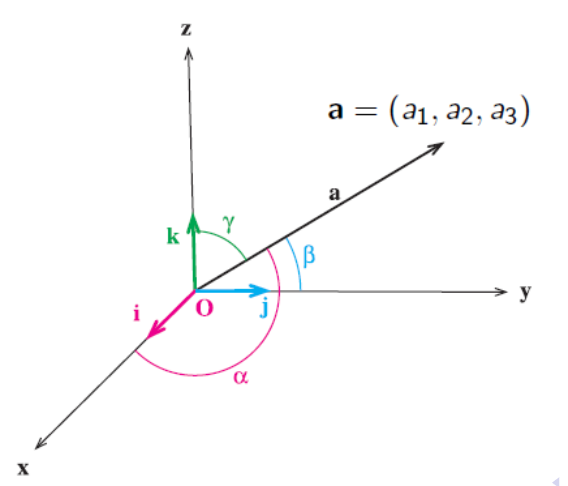
For a vector
2. Definitions
- Inner Product: A function that takes two vectors and produces a scalar, satisfying the properties of symmetry, linearity, additivity, and positive definiteness.
- Inner Product Space: A vector space that has an inner product defined on it.
- Dot Product: The most common type of inner product, calculated as the sum of the products of corresponding vector components (
- Orthogonal Vectors: Two vectors whose dot product is zero, indicating they are perpendicular to each other.
- Norm (Vector Length): The magnitude of a vector, calculated as the square root of the dot product of the vector with itself (
- Scalar Projection: The signed length of the projection of one vector onto another, resulting in a scalar value.
- Vector Projection: The vector that represents the “shadow” of one vector onto another. It is parallel to the vector being projected upon.
- Cauchy-Schwarz Inequality: A fundamental theorem stating that the absolute value of the dot product of two vectors is less than or equal to the product of their norms.
- Triangle Inequality: A property of norms stating that the norm of a sum of two vectors is no greater than the sum of their individual norms.
- Parallelogram Law: An identity relating the sum of the squares of the lengths of a parallelogram’s sides to the sum of the squares of its diagonals.
3. Formulas
- Algebraic Dot Product:
- Geometric Dot Product:
- Dot Product with Scalar Multiplication:
- Distributive Property of Dot Product:
- Dot Product and Norm:
- Vector Norm:
- Angle Between Vectors:
- Orthogonality Condition:
- Vector Projection:
- Scalar Projection (Component):
- Vector Decomposition:
- Parallelogram Law:
- Direction Cosines:
- Direction Cosines Identity:
- Vector Between Two Points:
- Median Vector:
4. Practice
4.1. Evaluate a Vector Expression (Lab 2, Task 1)
Evaluate
Click to see the solution
- Find the dot product: First, calculate the value of
- Substitute the values into the expression: Now substitute the given magnitudes and the calculated dot product into the expression.
- Expression =
² ² ² ²
- Expression =
- Simplify and calculate:
4.2. Find the Angle Between Vectors (Lab 2, Task 2)
Find the angle between the vectors
Click to see the solution
- Calculate the dot product:
- Calculate the magnitudes of the vectors:
² ² ² ² ² ²
- Use the angle formula:
- Find the angle:
4.3. Prove Vector Perpendicularity (Lab 2, Task 3)
Prove that vectors
Click to see the solution
- Recall the condition for perpendicularity: Two vectors are perpendicular if their dot product is zero. We need to show that
- Apply the distributive property of the dot product:
- Treat scalar products as scalars: The terms
- Use the commutative property of the dot product:
- Simplify the expression: The two terms are identical, so their difference is zero.
4.4. Calculate a Sum of Dot Products (Lab 2, Task 4)
All three vectors
Click to see the solution
- Start with the given vector sum:
- Take the dot product of the equation with itself:
- Expand the left side:
- Simplify and group terms: Using
² ² ² ² ² ² ²
- Substitute the known magnitudes: We are given
² ² ²
- Solve for the desired expression:
4.5. Find an Unknown Vector (Lab 2, Task 5)
There are two vectors
Click to see the solution
- Set up equations from the given conditions: Let
- Condition 1:
² ² ² - Condition 2:
- Condition 3: Angle between
- Condition 1:
- Process the third condition:
² ² ² - So,
- Solve the system of three equations:
- Eq 1:
² ² ² - Eq 2:
- Eq 3:
- Eq 1:
- Substitute Eq 2 into Eq 3:
- Substitute z back into the expression for y (Eq 2):
- Substitute y and z in terms of x into Eq 1:
² ² ² ² ² ² - Multiply by 4:
² ² ² - Combine terms:
² ²
- Find the possible values for x:
- Solution A:
- Solution B:
- Solution A:
- Calculate y and z for each solution:
- For Solution A (x = 0):
₁
- For Solution B (
₂
- For Solution A (x = 0):
4.6. Dot Product in R³ (Lecture 2, Example 1)
Calculate the dot product of
Click to see the solution
- Use the formula for dot product: For two vectors in
³ ₁ ₂ ₃ ₁ ₂ ₃ ₁ ₁ ₂ ₂ ₃ ₃ - Substitute the components:
- Calculate the result:
4.7. Dot Product Cancellation (Lecture 2, Example 2)
Assume
Click to see the solution
- Rearrange the equation: Start with the given equation
- Apply the distributive property: The dot product is distributive over vector subtraction.
- Interpret the result: This equation means that the vector
- Conclusion: The fact that
4.8. Vector Operations (Lecture 2, Example 3)
Given
Click to see the solution
- Use the scalar multiplication property: The dot product has the property that
- Apply the property:
- Substitute the given value: We are given that
4.9. Vector Operations (Lecture 2, Example 4)
Given
Click to see the solution
- Use the distributive property: The dot product distributes over vector addition:
- Substitute the given values: We are given that
4.10. Vector Operations (Lecture 2, Example 5)
Given
Click to see the solution
- Use the scalar multiplication property:
- Relate dot product to magnitude: The dot product of a vector with itself is the square of its magnitude:
² - Substitute into the expression:
² - Substitute the given value: We are given that
²
4.11. Parallelogram Law (Lecture 2, Example 6)
Given two vectors
Click to see the solution
- Expand the terms: Use the property that
² ² ² ² ² ² ²
- Add the expanded expressions:
² ² ² ²
- Simplify: The terms
² ² ² ² ² ²
4.12. Find the Angle Between Vectors (Lecture 2, Example 7)
Find the angle between
Click to see the solution
- Compute dot product:
- Compute magnitudes:
² ² ² ²
- Use the angle formula: The cosine of the angle
- Find the angle:
4.13. Determine if Vectors are Orthogonal (Lecture 2, Example 8)
Determine if the vectors
Click to see the solution
- Recall the condition for orthogonality: Two vectors are orthogonal if their dot product is zero.
- Compute the dot product:
4.14. Determine if Vectors are Orthogonal (Lecture 2, Example 9)
Determine if the vectors
Click to see the solution
- Recall the condition for orthogonality: Two vectors are orthogonal if their dot product is zero.
- Compute the dot product:
4.15. Determine if Vectors are Orthogonal (Lecture 2, Example 10)
Determine if the vectors
Click to see the solution
- Recall the condition for orthogonality: Two vectors are orthogonal if their dot product is zero.
- Compute the dot product:
4.16. Find the Vector Projection (Lecture 2, Example 11)
Find the vector projection of
Click to see the solution
- State the projection formula: The projection of vector
² - Compute the dot product:
- Compute the squared magnitude of w:
² ² ² - Substitute into the formula:
- Simplify and calculate:
4.17. Find the Angle in a Triangle (Tutorial 2, Task 1)
Given points
Click to see the solution
- Define the vectors: The angle is at vertex B, so we need the vectors originating from B.
- Calculate the dot product:
- Calculate the magnitudes:
² ² ² ²
- Use the angle formula:
- Find the angle:
4.18. Find an Unknown Vector Component (Tutorial 2, Task 2)
Find the value of
Click to see the solution
- Set the dot product to zero: Two vectors are orthogonal if their dot product is
- Calculate the dot product in terms of x:
- Solve the equation for x:
² ² ²
4.19. Prove the Identity for Direction Cosines (Tutorial 2, Task 3)
Suppose that a non-zero vector
Click to see the solution
- Define the direction angles: The angle between the vector
- Express cosines using the dot product formula: From the formula
₁ ₂ ₃ ₁ ₂ ₃
- Substitute into the identity:
² ² ² ₁ ² ₂ ² ₃ ²
- Simplify the expression:
₁ ² ² ₂ ² ² ₃ ² ² ₁ ² ₂ ² ₃ ² ²
- Use the definition of magnitude: The magnitude of
₁ ² ₂ ² ₃ ² ² ₁ ² ₂ ² ₃ ² ² ²
4.20. Prove the Law of Cosines using Vectors (Tutorial 2, Task 4)
For any triangle with side lengths
Click to see the solution
- Represent the triangle with vectors: Let two sides of the triangle be represented by vectors
- Use the dot product to find the squared length of C:
² ²
- Substitute and expand:
² ²
- Simplify using dot product properties: Since
² ² ² ²
- Substitute the geometric definition of the dot product: We know that
² ² ²
4.21. Find the Vector Projection (Tutorial 2, Task 5)
Find the vector projection of
Click to see the solution
- Recall the projection formula:
² - Calculate the dot product:
- Calculate the squared magnitude of b:
² ² ²
- Substitute the values into the formula:
- Simplify and calculate:
4.22. Find the Scalar Component (Tutorial 2, Task 6)
Find the scalar component of
Click to see the solution
- Recall the scalar component formula: The scalar component of
- Calculate the dot product:
- Calculate the magnitude of b:
² ² ²
- Divide the dot product by the magnitude:
4.23. Decompose a Vector (Tutorial 2, Task 7)
Decompose the vector
Click to see the solution
- Find the parallel component: The component of
²
- Calculate the necessary values:
² ² ² ²
- Calculate the parallel vector:
- Find the orthogonal component: The component of
- Calculate the orthogonal vector:
Answer:
- The vector parallel to
- The vector orthogonal to
4.24. Vector Dot Product in a Triangle with a Median (Homework 2, Task 1)
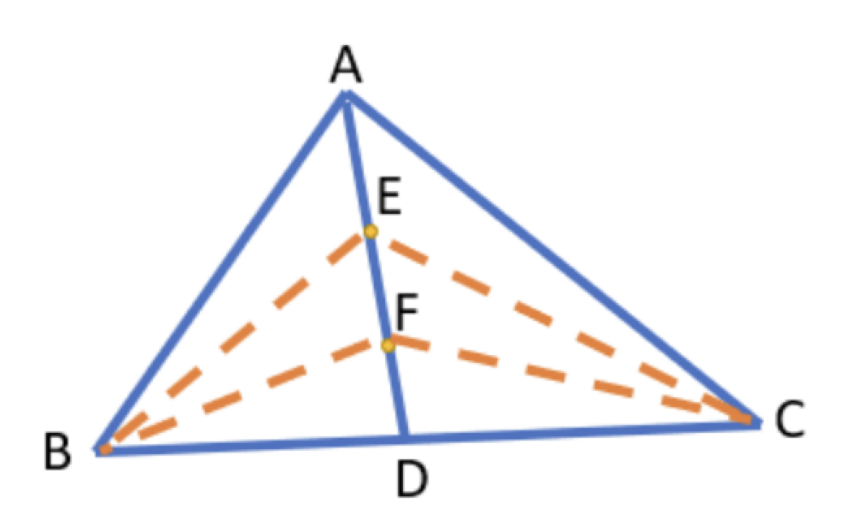
In triangle ABC, the median AD is divided into three equal segments: AE, EF and FD. Given:
Find
Click to see the solution
- Establish a vector basis: Let point A be the origin. We can define the vectors representing the sides of the triangle as
- Express points D, E, and F in terms of the basis:
- Since AD is the median, D is the midpoint of BC. Thus,
- The median AD is divided into three equal parts, so
- Similarly,
- Since AD is the median, D is the midpoint of BC. Thus,
- Use the given information to find relationships between b and c:
- First given:
- Second given:
- Substitute
- First given:
- Calculate the required dot product: We need to find
- Substitute the derived values: